
Specify the interface before the volume
A 3 mL cartridge is compatible only when the exact container, closures, holder and delivery mechanism are supported by the relevant system evidence. Nominal volume and a physical fit check do not establish interchangeability.
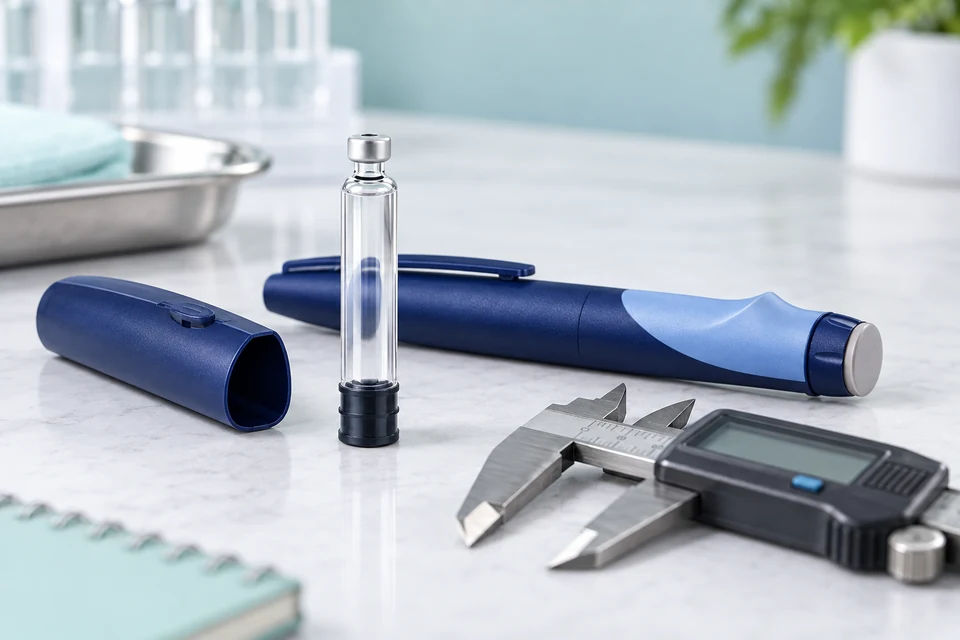
A request for a 3ml injection pen is a starting point, not a complete engineering specification. Nominal capacity does not describe the cartridge diameter, length, shoulder geometry, stopper, crimp or the way the mechanism engages the container. Two containers with similar volumes may behave differently inside the same body. Obtain controlled drawings and tolerance information for both sides of the interface. Record the intended fill volume and usable deliverable volume separately, because residual volume and the labeled operating sequence may affect what can actually be delivered. If the project includes a different formulation, the relevant compatibility questions extend beyond dimensional fit. Do not qualify a cartridge by placing one sample into a housing and checking that the cap closes. A documented system evaluation is needed before committing to supply.
Build a compatibility record that survives changes
A usable compatibility record identifies component revisions, acceptance criteria, evidence references and change approvers. A proposed substitute stays unverified until the responsible parties review its effect on the complete system.
A compatibility record should identify the device revision, cartridge revision, closures, needle interface and applicable test references. Store the acceptance criteria with the evidence, rather than recording only a pass or fail. Include who may approve a change to each component and how the other parties will be notified. A stopper supplier change or a tolerance revision can matter even when the commercial cartridge name stays the same. For a reusable pen, replacement instructions must point to the intended cartridge family and the appropriate reset procedure. Avoid publishing generic patient instructions that could be applied to a different device. In an RFQ, mark any proposed substitute as unverified until reviewed. This gives procurement a clear distinction between an approved configuration and an alternative that may require further engineering work.
Parameters & review checklist
- Device and cartridge drawing revisions
- Nominal, fill and deliverable volume
- Closure and stopper information
- Compatibility evidence and change ownership
Compatibility document matrix
| Interface | Controlled input | Review record |
|---|---|---|
| Cartridge to holder | Container and holder drawings | Dimensions and component revisions |
| Closure to mechanism | Stopper and drive configuration | Delivery evidence scope |
| Needle interface | Named needle and connection | Compatibility evidence |
| Replacement task | Exact device instructions | Reset and insertion review |
Apply this guide to your project
Use these configuration briefs to record the requirements discussed above, then prepare the document and quotation requests for your project.
Platform comparison and downloadable buyer worksheets ↗
Sample references and supplier evidence checklist ↗
Common questions
Can any 3 mL cartridge fit a reusable pen?
No. Volume is only one parameter. Use the exact compatible cartridge specified for the device.
Sources & further reading
- ISO 11608-1:2022: needle-based injection systems Reference page checked 6 October 2026.
External references describe their publishers’ products or guidance. Procurement tables are editorial decision aids; they do not establish conformity of a Hytanbio-Tech configuration.
Continue exploring
Buyer decision tools
Does a named medicine make a cartridge universally compatible?
No: insulin aspart, insulin lispro or a peptide name does not establish a universal cartridge-to-pen interface. Match the exact container and device references, then assess the relevant delivery and compatibility evidence for the intended presentation.
A nominal capacity is only one field in the interface record. The closure, holder, drive engagement and replacement sequence remain important even when the commercial medicine name is familiar. A third-party label may identify a specific compatible device family; that statement does not automatically extend to a different supplier’s body. Keep optional digital functions separate from the mechanical fit question. The insulin and peptide guides below show how to identify the presentation before a compatibility matrix is completed, helping buyers distinguish a documented baseline from a substitute that still needs investigation.