
What exactly is the shipment being qualified?
Define the packed configuration and its intended distribution route before requesting a transport-test quotation. The report should identify that same configuration clearly enough for the buyer and supplier to compare it with the proposed order.
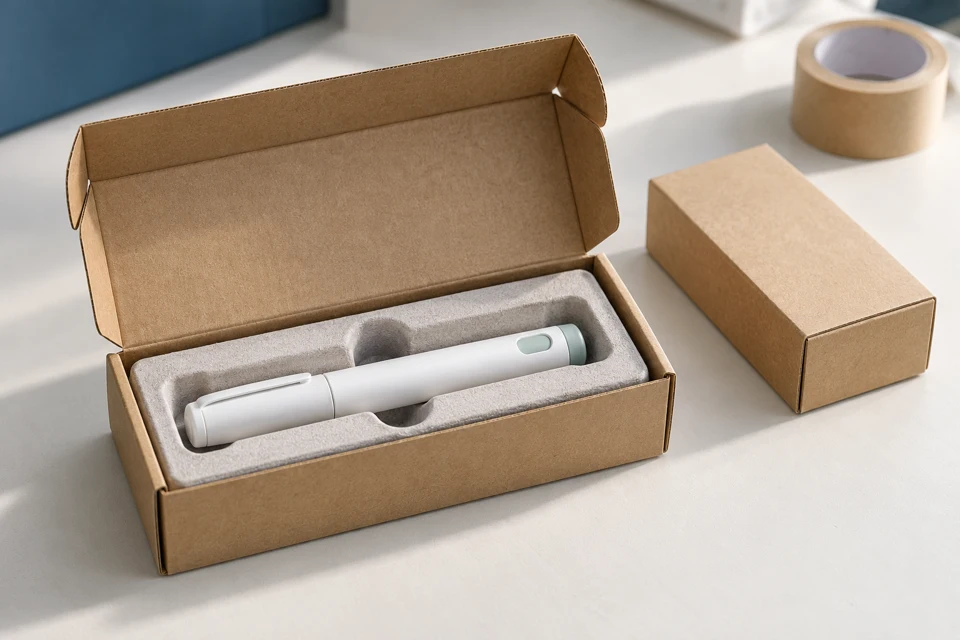
Consider a pen delivered in a fitted insert inside an individual carton. A bulk order may place several such cartons into a master shipper, while a sample order may travel as one parcel. Those arrangements give the packaging team different configurations to assess. Ask which one the laboratory received and whether the report describes the configuration that will leave the factory.
Keep the shipping unit separate from the sales unit in the RFQ. A retail box can be one part of a larger transport package. The purchasing record should identify the route assumptions and any onward repacking by a distributor, especially where the original evidence is being offered to support that later journey.
Inputs for the packaging brief
- Device configuration and packaging revision identifiers.
- Individual pack, master-carton and pallet arrangements where relevant.
- Pack count, gross weight and dimensions of the shipping unit.
- Delivery mode, handling route and any onward repacking.
- Product and packaging conditions that the evaluation must address.
Which transport-test reference fits the shipment?
Choose the reference against the actual distribution arrangement and document why it fits. A standard number on a quotation leaves the route, edition and evaluation scope unresolved.
ISTA lists Procedure 3A for individual packaged products in a parcel delivery system at 150 lb (70 kg) or less. This scope helps frame a parcel discussion; weight alone does not settle procedure selection. Ask the laboratory to identify the procedure version and explain its relevance to the proposed shipping unit.
ASTM D4169 addresses performance testing of shipping containers and systems in distribution environments. Its public scope also directs attention to D7386 for single-parcel shipments. These references need a justified project choice. The responsible packaging specialist should define the applicable plan and acceptance criteria; this article supplies no test sequence, severity level or universal sample quantity.
Shipping evidence review record
| Review subject | Record to request | Question for the handover |
|---|---|---|
| Shipping configuration | Pack-out drawing, identifiers and sample photographs | Does the tested package match the proposed shipment? |
| Distribution scope | Selected reference, version and route rationale | Why is this assessment relevant to the intended delivery? |
| Acceptance criteria | Agreed package and device checks | Which conditions must be acceptable after evaluation? |
| Barrier or temperature claim | Separate scope and responsible assessment | What conclusions fall outside the transport report? |
| Later changes | Revised specification and impact assessment | Can the earlier evidence still support this arrangement? |
What does a transit report leave unresolved?
Read the report against the protection claim being made: external damage, device condition, sterile-barrier integrity and temperature exposure involve different evidence questions. Ask which of those questions the report was designed to answer.
The public scope of ISO 11607-1:2019 concerns packaging intended to maintain the sterility of terminally sterilized medical devices. ISO also lists a 2023 amendment on risk management. The standard does not cover all requirements for aseptically manufactured devices, and its scope notes that drug/device combinations can need additional requirements.
For an injection pen project, identify the components that actually provide the relevant barrier. Keep their assessment connected to the exact presentation. If the shipment contains a medicinal product, assign responsibility for its temperature requirements and any excursion decision. A carton inspection should not silently become the basis for a drug-stability conclusion. Empty device shipments and filled medicinal presentations need their own documented scope.
How should buyers review the report and later changes?
Accept a transport report for the configuration, route assumptions and criteria it documents. Record any gap between that scope and the shipment being purchased before approving reliance on its results.
A report review can start with photographs and identifiers that connect the submitted sample to the pack-out drawing. Then check the agreed acceptance criteria, recorded observations and disposition of any deviation. Ask who approved the conclusion and whether there are open items affecting the proposed supply decision.
A later packaging change needs an applicability review. For example, replacing a fitted insert with a different material changes the arrangement that restrained the device, even if the outside carton looks the same. The responsible team should assess the consequences and document whether further evidence is needed. Keep that decision with the revised pack specification so the factory and buyer use the same accepted version.
Record the decision with the order
- Report identifier and the configuration it evaluated.
- Accepted packaging revision and intended delivery arrangement.
- Open deviations, exclusions and named decision owners.
- Change-notification and approval responsibilities for later substitutions.
Shipping-validation FAQ
Is ISTA 3A required for every injection pen shipment?
No universal requirement is established by this guide. ISTA describes 3A for individual packaged products in a parcel delivery system within its stated scope. The responsible packaging team should justify the procedure for the actual delivery route and packed configuration.
Does an intact outer carton prove that the pen still works?
Outer-carton appearance addresses only part of the assessment. The agreed acceptance criteria should identify the relevant device and package checks and the evidence needed for each. Review the recorded product results before accepting a functional claim.
Does passing a transit test prove a filled pen remained within its temperature limits?
A transit report needs a stated scope. Mechanical transport evidence alone does not establish that a medicine stayed within its permitted temperature exposure. The product owner must define and assess the applicable temperature requirements separately.
Does ISO 11607-1 apply to any injection pen presentation box?
ISO 11607-1 concerns packaging intended to maintain the sterility of terminally sterilized medical devices. A decorative or protective box does not acquire that scope through its appearance. Identify the actual sterile barrier and ask the responsible team which requirements apply.
Which packaging changes should be reviewed after testing?
Review changes to the insert, carton, pack count, device configuration or intended route for their effect on the existing evidence. Record the assessment and the responsible approval before carrying the earlier conclusion into the changed shipment.
References and editorial scope
- ISTA: test procedure scopes, including Procedure 3A for parcel delivery. Checked 24 October 2026.
- ASTM D4169: public title, scope and significance information. Checked 24 October 2026.
- ISO 11607-1:2019: official scope and listed 2023 amendment. Checked 24 October 2026.
The shipment scenarios and review table are original editorial purchasing guidance. Standards information comes from the linked official public scope pages. This article does not reproduce the full standards, define a test protocol or establish conformity of a HYTANBIO configuration.