
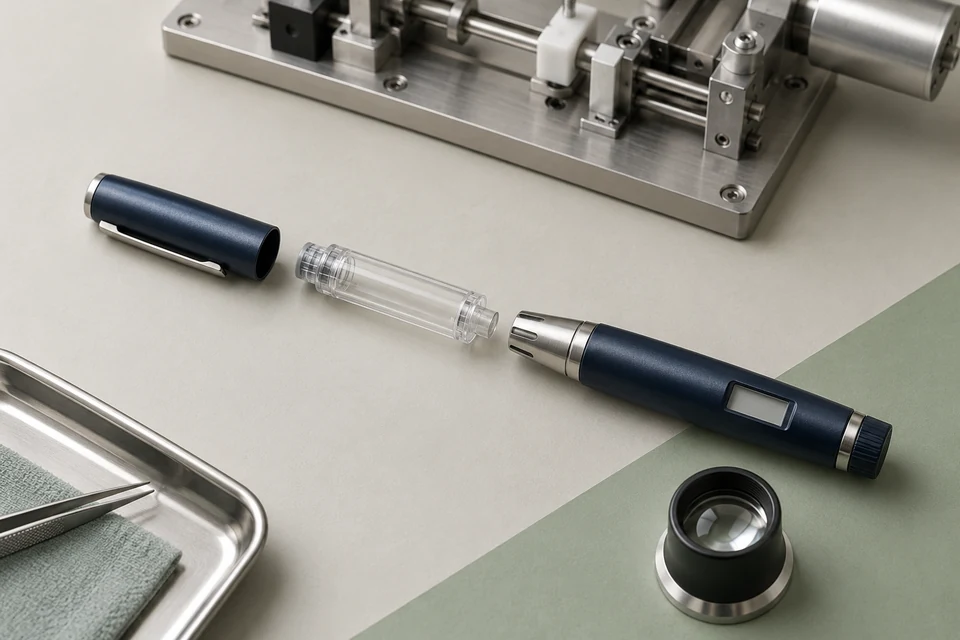
This page addresses engineering and procurement evidence for reusable, single-patient injection systems. It does not define a warranty, recommend a clinical reuse period or support sharing a pen between patients.
What belongs in a reusable-pen service-life claim?
A service-life claim needs a defined time or use basis, a representative operating sequence and acceptance criteria for the functions that must remain available.
Start with the intended use profile. Record the number and type of dose-setting actions, corrections, injections, cartridge changes, cap cycles and storage intervals represented by the claim. A cycle count without a sequence can miss wear created by end stops, partial settings or cartridge installation. State whether the test uses one container repeatedly, replaces containers at defined intervals or uses simulated components.
Separate service life from shelf life and drug stability. The pen body may remain in use while several containers are consumed, yet each container and medicine has its own approved storage and use conditions. Define the pen's cleaning and maintenance instructions without implying that a single-patient pen is a multi-patient reprocessing device. List the functions checked during and after endurance exposure, including dose setting, delivery completion, readable indication, mechanical integrity and safe cartridge retention. The claim should name the configuration and exclusions.
Claim fields to freeze
- Time or operating-cycle basis
- Representative use sequence
- Required functional checks
- Storage, cleaning and maintenance assumptions
How should mechanical endurance be evaluated?
Mechanical endurance should exercise the load paths and interfaces that experience wear, then verify performance at planned intervals and at the claimed endpoint.
A fixture can repeat dialling, correction, button travel and return, but it must not support or align the device in a way the user never does. Define actuator geometry, speed, dwell, torque or force limits and error detection. If a jam occurs, the method should record the unit and cycle rather than automatically reset the mechanism. Retain setup drawings and software versions for automated rigs.
Use representative component tolerances and lots where they can influence wear. Inspect threads, ratchets, drive elements, cartridge-holder retention, window readability and cap engagement as applicable. Functional checks should remain connected to the product requirements, including delivery outputs when endurance can affect them. Predefine how periodic checks change the sequence and whether removed units return to testing. A development run can locate weak interfaces, while formal verification needs an approved sample rationale, acceptance criteria, deviations and a conclusion limited to the tested configuration.
Endurance record contents
- Automated rig and software identification
- Cycle sequence and interruption log
- Periodic inspection and functional results
- Failed-unit examination and disposition
What changes when the reusable pen contains electronics?
Electronic service life adds power, firmware, stored data and interface behavior to the mechanical endurance question.
ISO 11608-4:2022 applies to needle-based injection systems containing electronics, with or without software. For a connected pen, define battery type, charging or replacement assumptions, power states, clock behavior, memory capacity, event definitions and communication interfaces. A device can continue to deliver mechanically while its display, dose memory or transfer function has degraded, so each claimed function needs its own failure criteria.
Record hardware and firmware versions with every test. Include low-power, full-memory, interrupted-transfer and reset conditions where the risk analysis requires them. Confirm what happens to stored events after battery depletion, service or a firmware update. Cybersecurity and privacy responsibilities belong in the product plan when the system transfers identifiable or treatment-related data. Do not extend a mechanical endurance result to electronic functions that were absent from the tested configuration. The release record should state which functions are essential to delivery, which are informational and how the user is told about an unavailable function.
Electronic lifecycle questions
- Which functions depend on power?
- What state is preserved after depletion or reset?
- How are firmware and hardware versions paired?
- How does the user detect a lost function?
Evidence review matrix
| Lifecycle layer | Evidence subject | Boundary to record |
|---|---|---|
| Mechanical | Setting, correction, drive, housing and container interfaces | Sequence, loads, component revisions and wear criteria |
| Electronic | Power, display, sensing, memory and communication | Hardware, firmware, battery and failure-state definition |
| User handling | Cap, cartridge change, cleaning and storage | Single-patient use and instructions represented |
| Commercial claim | Time or cycle statement | Configuration, exclusions and evidence owner |
| Post-release | Complaints, service information and changes | Review and re-evaluation triggers |
What should an OEM buyer request before approving the claim?
Request the claim statement, test protocol, configuration record, raw failure history and an applicability assessment for the proposed commercial variant.
A polished summary stating that a pen passed thousands of cycles leaves major questions unanswered. The buyer needs the operating sequence, sample rationale, device and component revisions, environmental conditions, fixture controls, interim checks, acceptance criteria and handling of failures. Ask whether the tested units used production tooling and production-equivalent components. If the product adds a new finish, container holder, electronics module or firmware, document which earlier evidence remains relevant.
Connect the endurance record to supplier change control and complaint review. A spring, lubricant, mould, battery or firmware change can alter the claimed life without changing the exterior. The quality agreement should define notification, assessment and release responsibilities. Under FDA's QMSR, the finished-device manufacturer remains responsible for the applicable quality-system records and controls. A supplier can provide component and device evidence, but the party making the finished-product claim must approve its scope and maintain the supporting configuration history.
Approval package
- Exact service-life wording
- Protocol and complete report
- Production-equivalence statement
- Change and complaint feedback route
Why can warranty, battery life and memory have different limits?
A commercial guarantee, an electronic operating period and stored-event capacity describe different product attributes. A buyer should retain each definition rather than combine them into one service-life number.
Novo Nordisk's Norwegian NovoPen 6 and NovoPen Echo Plus page states a three-year guarantee including dose memory, battery life of up to five years and storage for 800 injections. Those statements concern named third-party products in that market. They are not HYTANBIO performance claims or acceptance limits for another connected pen.
The procurement record should identify the function behind every lifecycle value. A memory capacity is not a number of mechanically permitted operations, and an electronic endpoint does not define the pharmaceutical container's in-use period. For a proposed OEM pen, request the mechanical claim, electronic claim and support terms separately. Review the actual instructions and controlled evidence for the configuration being purchased.
Keep the claims in separate fields
- Mechanical service-life basis
- Electronic functions and power limits
- Memory capacity and event definition
- Guarantee and market-specific terms
How can a use profile become a cycle-count worksheet?
Convert an agreed engineering use profile into counts for each distinct mechanism event. The arithmetic provides a planning input and does not itself demonstrate endurance.
For an explicitly hypothetical rig plan, two simulated delivery actuations per day over 365 days for three years produce 2 × 365 × 3 = 2,190 delivery actuations. This is an editorial calculation, not patient advice, a recommended treatment schedule, an ISO threshold or a measured HYTANBIO result. The assumptions must be replaced by the program's approved use profile.
Count dial corrections, cartridge replacements, cap operations and any priming sequence separately. They load different interfaces and may occur at different rates. A single total can hide a heavily used holder or an electronic event that records more often than delivery occurs. Show every assumption, rounding rule and interruption in the worksheet, then connect the resulting sequence to the verification rationale and representative device revisions.
Retain the calculation inputs
- Approved use-profile assumptions
- Event-specific counts and sequence
- Calendar exposure and storage conditions
- Verification rationale and configuration
Frequently asked questions
Is reusable pen service life the same as medicine shelf life?
No. The pen mechanism and the medicine-container presentation have separate lifecycle evidence. The finished program must keep both sets of conditions clear.
Can cycle testing use an empty pen?
An empty or simulated setup can support defined engineering questions. Its relevance to the final container, loads and delivery functions must be justified for the claim being made.
Does mechanical endurance cover Bluetooth or dose memory?
No. Electronic and software functions need evidence tied to the tested hardware, firmware, power conditions and data behavior.
Does a reusable pen mean it can be shared between patients?
No. ISO 11608-1 covers needle-based injection systems for single-patient use. Repeated use by one patient should not be described as multi-patient sharing.
Sources and editorial method
The purchasing questions, review matrix and explanations are original editorial analysis. Published product figures belong to the named third parties. Standards references use official public scopes; the full applicable standards and project evidence are needed for conformity decisions.
- ISO 11608-1:2022, Needle-based injection systems, Part 1. Checked 31 October 2026.
- ISO 11608-4:2022, Needle-based injection systems containing electronics. Checked 31 October 2026.
- FDA, Quality Management System Regulation. Checked 31 October 2026.
- Novo Nordisk Norway: NovoPen 6 and NovoPen Echo Plus. Checked 31 October 2026.
No HYTANBIO laboratory result, product certification, clinical assessment or compatibility approval is claimed. Corrections and source updates can be sent to info@hytanbio.com; see our editorial policy.