
This article is an engineering planning guide. It does not recommend a formulation, mixing time, dose, reconstitution method or approved use for any medicine.
What makes a dual-chamber pen a system rather than a container choice?
The mechanism, container, separated contents and user sequence form one delivery system with shared interfaces.
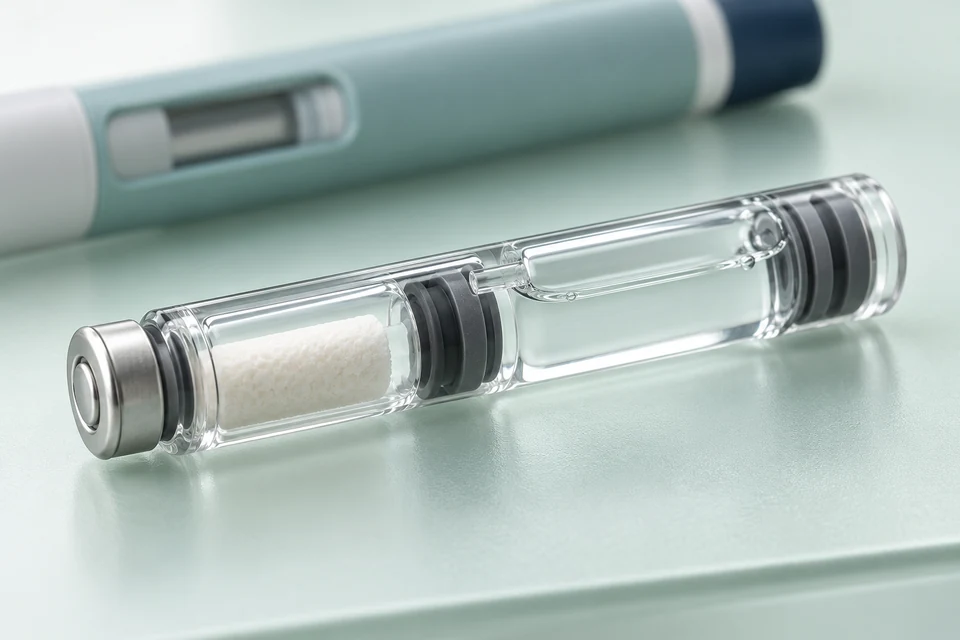
A dual-chamber cartridge commonly relies on controlled stopper movement and a bypass feature to bring separated components together. That description does not define one universal architecture. The device may advance a screw, translate a holder or use another mechanism to create the required travel. The project record should identify the container drawing, chamber order, stopper profiles, closure, plunger contact and orientation.
Translate each container event into a device requirement. The mechanism may need to prevent dosing before reconstitution, control travel through the bypass region, stop at a defined endpoint and provide feedback that the next user step can begin. Window geometry and labeling may need to support visual inspection. Keep mechanical evidence separate from pharmaceutical conclusions. A successful motion study can show that components move through a simulated sequence, yet it cannot establish formulation stability, complete mixing, sterility, container-closure integrity or suitability for a named medicine.
Interface map
- Front and rear chamber functions
- Intermediate and rear stopper geometry
- Bypass and usable travel
- Device contact, retention and viewing features
How should the reconstitution sequence become design inputs?
Convert the sponsor-approved sequence into measurable device states, allowed user actions and observable completion feedback.
Write the sequence step by step. Identify how the user begins reconstitution, which direction and amount the mechanism moves, whether pauses or mixing actions are required, and what indicates completion. Define the state that prevents premature dosing and the conditions that release it. If the user must inspect the contents, describe the viewing task and the instructions supplied by the medicine sponsor.
Set engineering requirements for travel, torque or force, feedback, lockout and error recovery where they belong to the device. Do not invent a mixing time or clarity criterion from the pen mechanism. Those pharmaceutical inputs need an approved source. Consider partial travel, reversed motion, repeated activation, interruption and attempts to dial a dose early. Human-factors work should examine whether intended users understand the sequence and can recognize an incomplete state. Bench tests then characterize the controlled mechanism and container response under representative tolerances and lifecycle conditions.
State definitions to document
- Before reconstitution
- Transfer or mixing in progress
- Reconstitution endpoint
- Ready-to-dose and blocked-error states
What verification evidence belongs to the container and fluid path?
Verification should trace the controlled container and integrated fluid path through the states needed for reconstitution and delivery.
ISO 11608-3:2022 provides the container and integrated-fluid-path framework. The protocol should identify container and stopper lots, dimensions, simulated contents, fill state, closure, device revision, needle configuration and conditioning. Evaluate the mechanical interfaces that can affect transfer, leakage, retention, blockage, breakage, particulates, usable volume and delivery outputs as required by the project risk analysis.
Use a surrogate only when its relevance to the test objective is documented. A low-viscosity liquid may help check travel while failing to represent the final formulation's flow or mixing behavior. Retain raw force or travel data, observations, failed sequences and post-test condition. State which results belong to the device, which depend on the container, and which remain with the pharmaceutical program. The published 2026 amendment to ISO 11608-3 should be reviewed when the project freezes its standards list; a citation to the series alone does not prove conformity.
Traceable test record
- Container and stopper identification
- Simulated content and test-purpose rationale
- Device, needle and closure configuration
- Conditioning, deviations and scoped conclusion
Evidence review matrix
| System state | Controlled input | Evidence question |
|---|---|---|
| Separated storage | Container, stoppers, closure and contents | Which configuration maintains the intended separation? |
| Transfer | Travel, force, bypass and orientation | Does the mechanism reach the defined endpoint without an unsafe state? |
| Mixing or inspection | Sponsor sequence and user feedback | Can the intended user recognize completion or an incomplete state? |
| Dose preparation | Lockout release, setting and needle state | Can dosing begin only from the accepted state? |
| Delivery | Integrated fluid path and final presentation | Which delivery outputs remain verified after reconstitution? |
What should a dual-chamber OEM brief contain?
The brief should separate approved pharmaceutical inputs from device-development questions and assign an owner to every unresolved interface.
Provide the controlled container drawing, chamber order, target presentation, intended users, approved user sequence and available formulation constraints. Identify whether the request is a feasibility model, engineering prototype, verification unit or production program. State which party owns the container, filling process, stability work, reconstitution criteria, device mechanism, human factors and market submission.
Ask the device supplier to return an interface review before promising tooling or schedule. That review should list missing dimensions, tolerance assumptions, travel budget, force questions, feedback concept, lockouts, sample purpose and evidence needed for the next decision. A catalogue pen should not be presented as compatible because its holder accepts a similar cartridge diameter. Use staged approvals: interface feasibility, mechanism concept, representative container trials, design verification and production authorization have different evidence thresholds. The quality agreement should define change notification for the container, stoppers, closure, device parts and assembly process.
Responsibility matrix
- Formulation and mixing criteria
- Container and filling controls
- Device mechanism and user interface
- Final combination-product evidence and submission
What do current container and device references actually specify?
A container supplier and a mechanism supplier may describe different parts of a dual-chamber system. Read the exact product column and named variant before transferring a parameter into an OEM brief.
SCHOTT Pharma describes a bypass that permits transfer between chambers and lists its double-chamber format as customized upon request. The 1.5–3 mL range in the shared comparison table belongs to the neighboring cartriQ column; it should not be assigned to the double-chamber product. Request its controlled drawing and available format for the proposed project.
Ypsomed's LyoTwist page distinguishes manual Trio and Vario from automatic Trio S and Vario S. It lists up to six settings for Vario and up to eight for Vario S within a dual-chamber monodose family. These published examples illustrate architecture choices. They do not establish HYTANBIO availability, regulatory status, interchangeability or permission to reproduce another manufacturer's design.
Record the source with the parameter
- Exact container family and drawing
- Manual or automatic delivery architecture
- Named variant and setting definition
- Licensing and evidence responsibilities
What is a practical first feasibility decision?
The first decision is whether the controlled container and proposed mechanism can reach the required states with a credible travel and force budget. Pharmaceutical acceptance remains a separate input from the medicine sponsor.
Prepare a dimensional stack covering holder retention, plunger contact, stopper positions, bypass travel and the final delivery stroke. Identify tolerances rather than using only nominal dimensions. Record the state in which transfer begins, the observable endpoint and the feature that blocks early dosing. A visual concept is useful for discussion but cannot establish those interfaces.
The first sample request should name the question it will answer: travel observation, interface fit, force characterization or user-sequence feedback. Define the surrogate and its limits, then agree what result permits the next development stage. Keep the container lot and drawing revision with the sample record. ISO 11608-3:2022 has a published 2026 amendment; confirm the applicable edition and amendment in the project standards register before the verification protocol is approved.
A useful feasibility handover
- Controlled dimensional stack
- State sequence and incomplete-state response
- Sample purpose and surrogate justification
- Open risks and next evidence decision
Frequently asked questions
Can any standard injection pen use a dual-chamber cartridge?
No. The mechanism, holder, travel, force, lockout, viewing and fluid-path interfaces must be designed and verified for the controlled container and sequence.
Does a mechanical transfer test prove complete reconstitution?
No. It can answer a defined device question. The medicine sponsor must define and support the pharmaceutical mixing and acceptance criteria.
Can water always be used as the test liquid?
A surrogate may support a specific engineering test when its relevance is justified. It does not automatically represent the final formulation's flow, mixing or stability behavior.
Who owns the final dual-chamber compatibility claim?
The responsible finished-product sponsor or manufacturer must approve the combined evidence. Device and container suppliers provide scoped records for their controlled responsibilities.
Sources and editorial method
The purchasing questions, review matrix and explanations are original editorial analysis. Published product figures belong to the named third parties. Standards references use official public scopes; the full applicable standards and project evidence are needed for conformity decisions.
- ISO 11608-3:2022, Containers and integrated fluid paths. Checked 31 October 2026.
- ISO 11608-1:2022, Needle-based injection systems, Part 1. Checked 31 October 2026.
- FDA, Container Closure Systems for Packaging Human Drugs and Biologics. Checked 31 October 2026.
- FDA, Application of Human Factors Engineering Principles for Combination Products. Checked 31 October 2026.
- SCHOTT Pharma: double-chamber cartridges. Checked 31 October 2026.
- Ypsomed LyoTwist: named variants and settings. Checked 31 October 2026.
- ISO 11608-3:2022/Amd 1:2026. Checked 31 October 2026.
No HYTANBIO laboratory result, product certification, clinical assessment or compatibility approval is claimed. Corrections and source updates can be sent to info@hytanbio.com; see our editorial policy.