
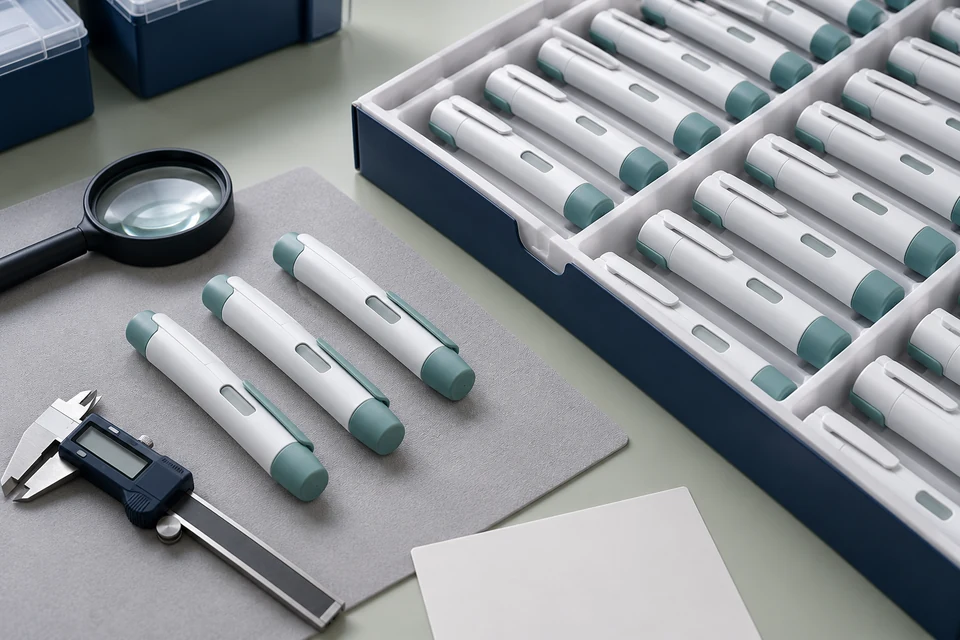
This guide explains procurement and quality-planning concepts. It does not prescribe an AQL, sample size, critical-defect rule or release decision for a specific device or market.
What does AQL mean for an incoming injection-pen lot?
AQL indexes a sampling scheme for lot acceptance; it does not describe the exact defect percentage inside one accepted shipment.
ISO 2859-1:2026 addresses inspection by attributes for a continuing series of lots. The plan links lot size, inspection level and AQL to a sample-size code and acceptance or rejection numbers. The standard also uses switching rules so inspection severity can respond to the history of submitted lots. A buyer should record the edition used because the 2026 third edition replaced the 1999 edition and its amendments.
Acceptance sampling makes a probabilistic decision from a sample. It creates producer and consumer risks that need to be understood by the responsible quality team. An accepted lot can still contain nonconforming units, and a conforming lot can be rejected by the plan. AQL should therefore sit inside a broader supplier-control system. It cannot replace an adequate specification, capable process, traceability, complaint feedback or special control for a characteristic where a sampling plan does not provide acceptable protection.
Plan identifiers to record
- Standard edition and plan type
- Lot size and inspection level
- AQL index and sample-size code
- Acceptance, rejection and switching rules
How should the lot and random sample be defined?
A useful sampling decision starts with a lot that represents one controlled production and traceability context, followed by a genuinely random selection method.
Define the supplier, manufacturing site, component number, revision, material or colour where relevant, production period and traceability identifier. Avoid combining units from different moulds, cavities, processes or revisions when that mixture prevents meaningful disposition. If the shipment contains several traceable sublots, state whether each is inspected separately or how the plan treats them.
Random selection should reach the full lot, not only cartons nearest the door. Record carton or pallet locations and the method used to select units. A convenience sample can miss clustered defects and does not support the planned statistical decision. Protect samples from damage during withdrawal and preserve their identity through inspection. For destructive or functional tests, define whether sampled units return to stock. If a supplier resubmits a rejected lot after sorting or rework, keep the original disposition, rework record and new lot identity connected rather than treating the shipment as an untouched first submission.
Lot record fields
- Supplier, site and process
- Part number, revision and component lots
- Shipment and production traceability
- Sampling locations and selected-unit identities
How should defect categories and inspection methods be set?
Classify characteristics from device risk and specification impact, then use an inspection method capable of detecting the defined nonconformance.
A cosmetic mark, a dimension that affects cartridge retention and a feature that can prevent dose delivery do not carry the same consequence. Define each nonconformance in observable terms and connect it to the drawing, specification or approved visual standard. Avoid labels such as major or minor without a written example or decision rule. The responsible quality and engineering teams should identify characteristics that need a special control outside a routine AQL plan.
Confirm that gauges, fixtures and visual conditions are suitable. A sample plan cannot correct a measurement system that cannot distinguish conforming from nonconforming parts. Record calibration, resolution, lighting, magnification and operator qualification as applicable. Attribute inspection produces a conforming or nonconforming decision, while variable data can provide different information about process distribution. Choose the method that supports the requirement. Keep destructive tests, functional tests and appearance checks separate when they use different samples or disposition rules.
Characteristic review
- Requirement and defect definition
- Risk and downstream device effect
- Inspection method and measurement capability
- Sample disposition and escalation route
Evidence review matrix
| Decision layer | Required definition | Common error to avoid |
|---|---|---|
| Lot | Traceable production and shipment boundary | Combining unrelated revisions or process histories |
| Sample | Random selection across the accessible lot | Taking only convenient cartons or top-layer units |
| Characteristic | Observable requirement and capable method | Using vague defect labels without examples |
| Plan | Edition, level, AQL and switching procedure | Treating AQL as the allowed defect rate in one lot |
| Disposition | Acceptance, rejection, rework and resubmission records | Erasing the first rejection after sorting |
What supplier evidence should accompany incoming inspection?
Incoming inspection should use supplier records and process knowledge without turning a certificate into an automatic release decision.
Request the purchase specification, approved revision, certificate or test record where required, lot traceability and change status. Review whether the supplier's evidence covers the same characteristic and lot as the receiving decision. A generic material declaration or an earlier dimensional report may support supplier qualification but does not establish that the current shipment meets every device requirement.
Use inspection history to manage the relationship. ISO 2859-1:2026 includes switching concepts for a continuing series of lots; apply them through a controlled procedure rather than informal sample reduction. A failed lot needs documented containment, disposition, supplier response and evaluation of units already used. Under FDA's QMSR, finished-device manufacturers need applicable quality-system controls and records. The quality agreement should assign notification, deviation, rework, resubmission and record-retention responsibilities. Reduced inspection does not remove the supplier's duty to meet the specification or the buyer's responsibility for the finished-device decision.
Evidence package
- Approved specification and purchase revision
- Lot-specific supplier records
- Incoming result and disposition
- Corrective action, change and trend history
Why can a sample miss a defective unit?
A sample can contain no observed defects even when nonconforming units exist in the population. The probability depends on the sampling assumptions and does not equal the AQL label.
Consider an editorial binomial example with 80 independent observations and a constant 1% probability of nonconformance per observation. The chance of detecting at least one is 1 − 0.99⁸⁰, approximately 55.2%; the chance of observing none is approximately 44.8%. These are transparent illustrative calculations, not an ISO 2859-1 sampling plan, a recommended sample size or factory inspection data.
A finite lot sampled without replacement can require a different probability model, and clustered defects can violate the independence assumption. The example explains why zero observed defects does not prove a defect-free shipment. NIST describes acceptance sampling as a decision about lot disposition. Its purpose should be distinguished from estimating the exact lot quality or demonstrating long-term process capability.
State the model before using the number
- Population and sampling method
- Independence or finite-lot assumptions
- Detection event being calculated
- Limits of the resulting conclusion
How should a failed lot be contained and dispositioned?
Quarantine the affected lot, preserve the original inspection record and authorize a documented disposition before the material is used. An inspection failure should remain traceable after sorting, rework or resubmission.
Record the characteristic, sample identities, method, observed nonconformances and the acceptance rule that triggered the decision. Identify related stock and units already introduced into assembly. Assign responsibility for the supplier investigation and assess whether the finding changes the status of earlier lots. A deviation request should name the requirement and permitted scope rather than silently revise the inspection criterion.
If sorting or rework is approved, define its method, measurement capability, segregation and verification. Retain the new traceability link and resubmission decision. Incoming attribute inspection does not replace dose-accuracy verification, container-closure work, force testing or design validation. Those activities answer different product questions. Close the receiving decision with an authorized release, return or other approved disposition and retain the evidence in the supplier's performance history.
Close the loop with an auditable record
- Containment scope and affected inventory
- Authorized disposition and rationale
- Rework or sorting verification
- Supplier response and inspection-history update
Frequently asked questions
Does AQL mean the supplier may ship that percentage of defects?
No. AQL indexes an acceptance-sampling scheme and relates to process-average performance in the system. It is not permission to knowingly ship nonconforming product.
Can one AQL value be used for every injection pen component?
No universal value is appropriate. The responsible team should consider the characteristic, device risk, process knowledge, inspection system and commercial agreement.
Does an accepted sample prove every unit conforms?
No. Acceptance sampling makes a probabilistic lot decision. Supplier controls, process capability, traceability and post-release feedback remain necessary.
Can incoming inspection be reduced after good supplier performance?
A controlled sampling system can include reduced or skip-lot provisions and switching rules. Apply the current standard and the buyer's approved procedure rather than reducing inspection informally.
Sources and editorial method
The purchasing questions, review matrix and explanations are original editorial analysis. Published product figures belong to the named third parties. Standards references use official public scopes; the full applicable standards and project evidence are needed for conformity decisions.
- ISO 2859-1:2026, AQL-indexed sampling schemes for lot-by-lot inspection. Checked 31 October 2026.
- ISO 28590:2017, Introduction to the ISO 2859 series. Checked 31 October 2026.
- FDA, Quality Management System Regulation. Checked 31 October 2026.
- NIST/SEMATECH: what is acceptance sampling?. Checked 31 October 2026.
No HYTANBIO laboratory result, product certification, clinical assessment or compatibility approval is claimed. Corrections and source updates can be sent to info@hytanbio.com; see our editorial policy.