
Which configuration is actually being transferred?
Identify the pen by a controlled configuration record that connects the device to its drawings, components and acceptance criteria. Record the revision of each document that the receiving manufacturer will use.
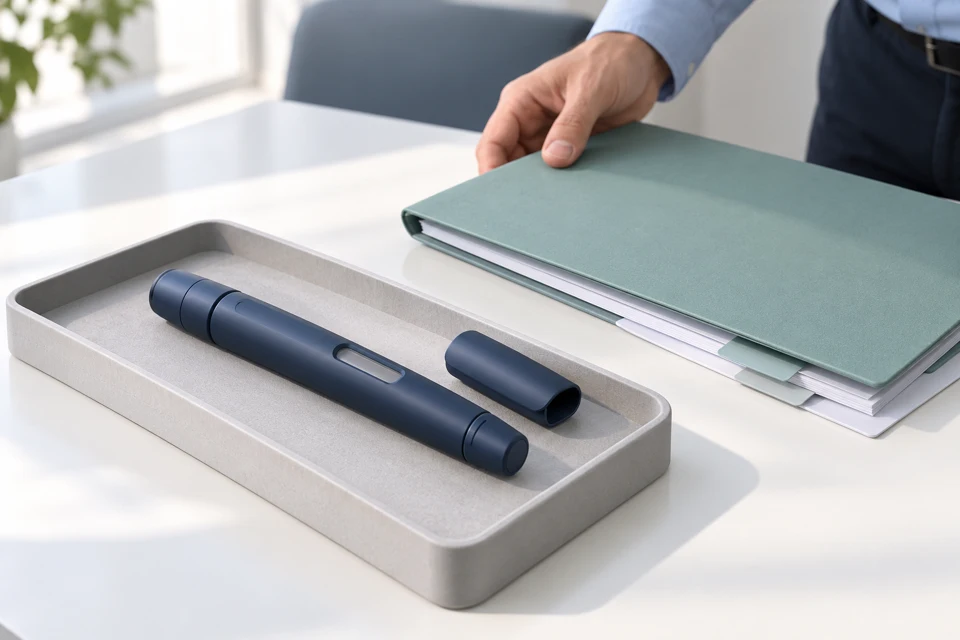
Consider a reusable cartridge pen whose appearance sample has been approved. The sample can establish the selected finish, but the production team still needs to know which cartridge holder belongs to that version and where its interface requirements are recorded. A photograph cannot resolve a revision mismatch between the bill of materials and a drawing.
Request a transfer index that names the relevant records and their owners. The index can point to controlled files held by different parties; access and confidentiality arrangements need agreement before production planning relies on them. Any unresolved item should have a named owner and a clear effect on the purchasing decision. For example, approval to prepare packaging artwork can proceed under a different authorization from approval to build devices.
Records to put in the transfer index
- Device configuration identifier and drawing revisions.
- Bill of materials (BOM), component specifications and approved supplier references.
- Applicable verification and validation report identifiers.
- Manufacturing and inspection document references, including acceptance criteria.
- Labeling, packaging and software versions where they belong to the supply scope.
What evidence connects the design to manufacturing?
The receiving team needs evidence that the design outputs are suitable for its manufacturing approach and that production capability can meet the device requirements. FDA's QMSR training describes those transfer objectives under ISO 13485 clause 7.3.8, on slide 27.
For procurement review, ask how the evidence identifies the actual component sources and document revisions used. If an earlier sample used a different holder, finish or assembly arrangement, the technical owner should explain which conclusions carry across and which need further work. A report title alone gives the buyer little basis for that decision.
Keep design verification, validation and manufacturing readiness visible as separate review subjects. Their records can support one another, but the agreement should state what each approval covers. The following table is an editorial purchasing aid. It does not prescribe a manufacturing method, test limit or sample size.
Transfer review record
| Review subject | Record to request | Question for the handover |
|---|---|---|
| Configuration baseline | Drawings, BOM and revisions | Can both parties identify the same device? |
| Evidence applicability | Report identifiers and configurations evaluated | Which proposed requirements does the evidence support? |
| Receiving capability | Documented assessment and responsible reviewer | Can the receiving operation meet the defined requirements? |
| Pilot authorization | Purpose, quantity rationale and permitted use | What decision will this build support? |
| Release and changes | Approval roles, deviation route and lot identification | Who can authorize the next supply step? |
How does the 2026 QMSR affect a U.S. supplier review?
FDA's Quality Management System Regulation became effective on 2 February 2026 and incorporates ISO 13485:2016 by reference into 21 CFR Part 820. For a U.S. project, assign a regulatory owner to determine which requirements apply to the finished device and each party's role.
FDA's QMSR overview is the current starting point for that review. Older documents may use references from the previous Quality System regulation. Ask the supplier how its document set maps to the applicable current framework, especially where an older report supports the proposed configuration.
Certificate scope deserves its own check. ISO explains that ISO 9001 serves a broad range of industries, while ISO 13485 addresses medical device quality management. A company's certificate should be reviewed alongside the activities and sites it covers. This article does not assess Hytanbio-Tech's conformity or establish the market status of any catalogue configuration.
Design-transfer FAQ
Does approving an injection pen sample authorize mass production?
Sample approval covers the purpose recorded in that approval. Production authorization needs an agreed configuration, applicable evidence and release responsibilities. A color sample or display model may settle appearance while other requirements remain open.
Is there a standard number of pilot units every pen project must build?
This guide sets no universal pilot quantity. The responsible team should justify the quantity and evaluation plan for the intended decision, production approach and applicable requirements. Ask what the selected samples can support and what remains unassessed.
Can an ISO 9001 certificate replace a device-specific quality assessment?
ISO 9001 has a broad industry scope; ISO 13485 addresses medical device quality management. Review the applicable requirements, certificate scope and configuration records for the proposed project. Neither a general company certificate nor a catalogue description establishes device-specific conformity.
Who should approve a supplier substitution after design transfer?
The quality agreement should identify who assesses the change and who authorizes implementation. The supplier should provide the affected component or document revision and the impact assessment before the agreed approval decision.
Does an ISO 13485 certificate remove the need for an FDA inspection?
No. FDA states in QMSR FAQ 13 that a certificate of conformance to ISO 13485 does not exempt a manufacturer from an FDA inspection. Certificate review and inspection readiness address different parts of supplier assessment.
References and editorial scope
- FDA: QMSR design and development training, slide 27 on transfer. Checked 24 October 2026.
- FDA: Quality Management System Regulation, effective 2 February 2026. Checked 24 October 2026.
- FDA: QMSR frequently asked questions, especially question 13. Checked 24 October 2026.
- ISO 13485:2016: official scope and comparison with ISO 9001. Checked 24 October 2026.
The transfer index, scenario and purchasing table are original editorial guidance for an OEM discussion. Regulatory statements refer to the linked official materials. The ISO reference is its public scope page; this article does not reproduce the full standard or set a test protocol.