
Clarify what OEM and ODM mean for this project
Define OEM or ODM scope by the deliverables and responsibilities in the proposal, rather than by the service label alone. Branding, mechanism development, filling and product release require different inputs and evidence.
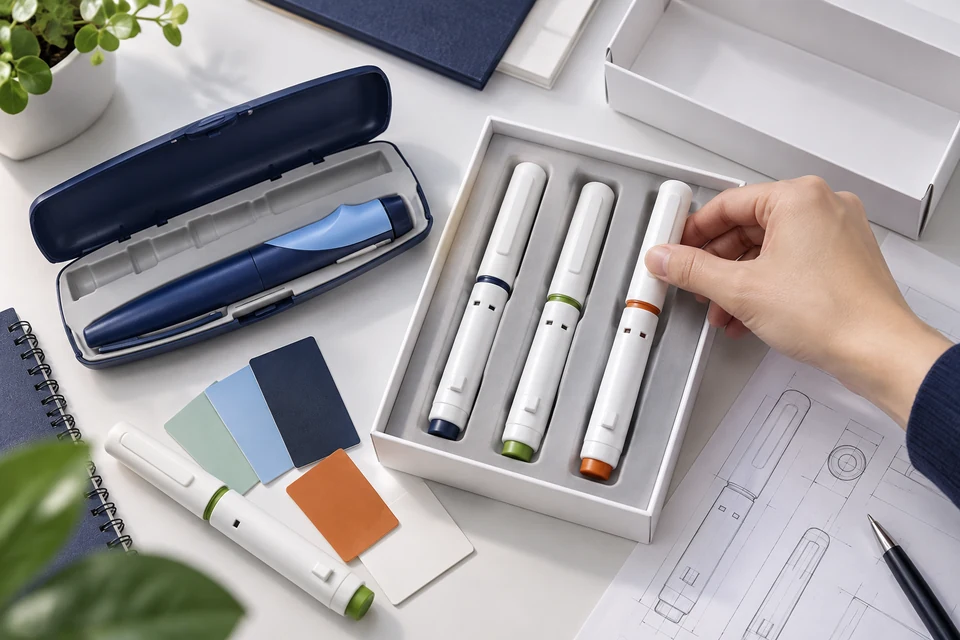
OEM injection pen and ODM injection pen are commercial terms whose meaning can vary between suppliers. One offer may cover assembly to a buyer-owned design; another may involve adapting a supplier platform. Write down who owns the design, tooling, software, verification evidence and final labeling. Separate cosmetic customization from changes to the dose mechanism, container interface or digital functions. A private label injection pen project can still raise important questions about traceability and product responsibility. Ask for a written scope that identifies included work, exclusions and assumptions. If an injection pen prototype is proposed, label its purpose clearly: appearance, handling, engineering investigation or another defined stage. A prototype should not be described as a released device or supplied for clinical use merely because it looks like a finished product.
Use development gates with defined outputs
Use development gates with a named owner, output and acceptance decision for each stage. Appearance approval does not close compatibility, verification or destination-market questions.
A workable development sequence starts with requirements, proceeds through concept and feasibility review, and then defines verification, production preparation and release activities appropriate to the project. Each gate should have a tangible output, an owner and acceptance criteria. For example, a concept review can confirm the proposed architecture while leaving a compatibility test as an open item. Do not use a sample approval to imply that every technical and regulatory question is closed. The commercial schedule should distinguish tooling, component supply, testing and any externally controlled review. Record what happens if a requirement changes after a gate is accepted. This reduces disputes over price and timing and gives both parties a clear basis for the next decision. Confirm the actual scope and schedule in the project agreement.
Parameters & review checklist
- Design and tooling ownership
- Customization boundaries
- Gate outputs and acceptance criteria
- Verification, release and market responsibility
Apply this guide to your project
Use these configuration briefs to record the requirements discussed above, then prepare the document and quotation requests for your project.
Platform comparison and downloadable buyer worksheets ↗
Sample references and supplier evidence checklist ↗
Common questions
Is logo customization the same as a new ODM platform?
No. Branding changes and a new mechanism have different engineering, evidence and ownership implications.
Sources & further reading
- FDA: technical considerations for pen and jet injectors Reference page checked 6 October 2026.
External references describe their publishers’ products or guidance. Procurement tables are editorial decision aids; they do not establish conformity of a Hytanbio-Tech configuration.
Continue exploring
Buyer decision tools
From sample approval to production
Injection Pen Design Transfer: What to Confirm Before Production